
Get Featured in Google's AI Overviews: Local SEO Tips

How Henry County & Greater Atlanta Small Businesses Can Get Featured in Google's AI Overviews
AI is changing how customers search, and Google's AI Overviews are now front and center. For local businesses in Henry County and the Greater Atlanta area, learning how to show up in these AI-powered summaries can mean more calls, more visits, and more revenue.

Get Your Local Business Into Google's AI Overviews
Turn modern search into real customers in Henry County and Greater Atlanta
What Exactly Are Google AI Overviews in 2026?
AI Overviews are Google's AI-generated summaries that appear at the top of many search results. Instead of only showing a list of blue links, Google now uses its Gemini 3 model to read through web pages, understand the topic, and present a concise, conversational answer right away. From there, users can tap to ask follow-up questions in a chat-like experience while Google keeps the original context in mind (blog.google).
In May 2026, Google shared that AI Overviews now reach around 2.5 billion monthly users, making them one of the most widely used features in all of Search (TechRadar, Google I/O 2026). They're no longer an experiment; they're how a huge share of people get answers every day.
For a local search like "best HVAC repair near McDonough" or "family dentist in Stockbridge," an AI Overview might appear at the top of the page, summarizing the best options, what to look for, and sometimes naming specific businesses and linking to their sites or profiles. That's the visibility you want.
Why AI Overviews Matter So Much for Local Businesses
If you run a restaurant in Locust Grove, a law firm in downtown Atlanta, or a salon in Hampton, you're already competing for attention in Google Search and Maps. AI Overviews introduce a new "top layer" above traditional results, and that layer can strongly influence which businesses customers consider first.
- Prime screen real estate: AI Overviews often occupy most of the screen on mobile devices, especially on first load. If your business is cited there, you're effectively "first in line" when customers are deciding where to call or visit.
- Trust and credibility: Google is working to highlight credible, original sources in AI Overviews through features like "Preferred Sources" (Android Central, 2026). If your content is clear, authoritative, and locally relevant, you're more likely to be chosen as a trusted source.
- Local buying intent: Many AI Overview queries are high-intent searches like "emergency plumber near me" or "late-night tacos in Atlanta." Showing up there can translate directly into calls, bookings, and walk-ins.
Researchers are already tracking how AI Overviews affect traffic to websites and publishers (arXiv, 2026). While some clicks may stay within Google's interface, businesses that are cited in the Overview or linked as a source can still gain highly qualified visitors. The key is positioning your business so the AI sees you as helpful, local, and trustworthy.
The New Playbook: Optimizing for AI Overviews (AEO, Not Just SEO)
Marketers have started calling this shift "AEO" – AI Engine Optimization: creating content that not only ranks in traditional search, but is also easy for AI systems to summarize and feature (Moz, Search Engine Journal). For Henry County and Greater Atlanta businesses, that means:
- Structuring your website content so AI can quickly understand who you are, what you do, and where you serve.
- Answering real customer questions directly on your site, in clear, conversational language.
- Sending strong local signals through your Google Business Profile and other local listings.
📌 Key Takeaway: You're no longer just optimizing for a human skimming your website. You're also optimizing for an AI that needs to instantly understand and summarize your business for local customers.
Step 1: Build Structured, Scannable Content on Your Website
Google's AI models perform best when your content is organized. They look for clear headings, short paragraphs, and logical sections that mirror how a helpful human would explain something. According to modern SEO best practices, structured content and clear formatting make it easier for Google's AI to extract direct answers (Search Engine Watch).
Use Headings to Mirror Real Questions
- Turn common customer questions into headings, especially on service and location pages. For example: "How much does HVAC repair cost in Henry County?" or "What should I look for in a personal injury lawyer in Atlanta?"
- Answer those questions directly in the first one or two sentences under each heading. This makes it easy for AI to pull a concise answer into an Overview.
Format for Quick AI "Copy & Paste"
- Use short paragraphs (2–4 sentences) and bullet lists for steps, tips, or pros and cons. AI systems often favor these for summaries and featured snippets (Search Engine Journal).
- Include a brief "summary paragraph" at the top of key pages that clearly explains who you serve and what you offer. Example for a Fayetteville-based roofer: "We provide same-day roof inspections and repairs for homes across Henry County and South Atlanta, including McDonough, Stockbridge, and Jonesboro."
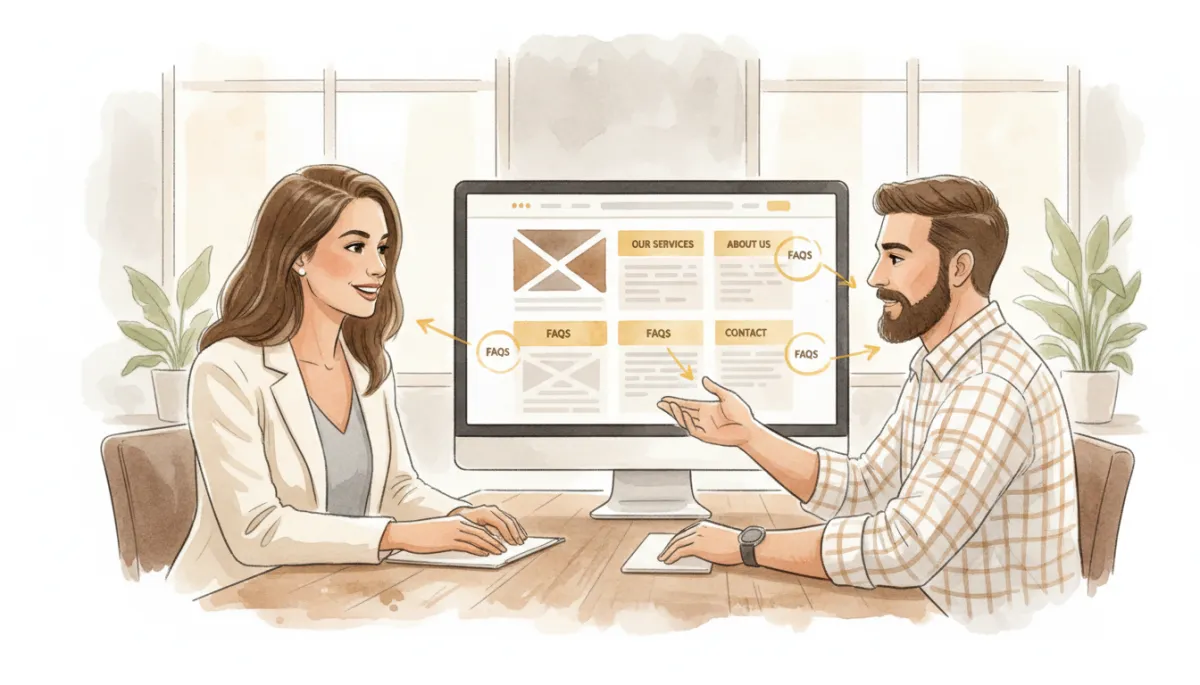
Clear headings and concise answers make it easier for Google's AI to feature your business.
Step 2: Add Helpful FAQ Sections That Match Real Searches
FAQ sections are one of the most powerful tools for AI Overview optimization. They naturally present information in a question-and-answer format, which is exactly how people search and how AI wants to respond. Many guides on optimizing for Google's AI features recommend directly answering common questions to improve your chances of being surfaced (Search Engine Journal).
How to Build a Strong Local FAQ Section
- Collect real questions from your customers: emails, phone calls, front-desk conversations, and social media messages. Ask your staff, "What do people ask us every day?"
- Localize the wording of your FAQs. Instead of "Do you offer delivery?", use "Do you offer delivery in Henry County and South Atlanta?" so the AI connects your answer to local intent.
- Answer in 1–3 sentences, using clear, everyday language. Avoid jargon. AI systems favor concise, direct responses over long, promotional paragraphs.
Where to Place FAQs on Your Site
- Create a dedicated "FAQ" page that covers general questions about your business, service area, and policies.
- Add smaller, focused FAQ sections to individual service pages. For example, an "Invisalign FAQ" on a dental site or a "Same-Day Repair FAQ" on an appliance repair page.
💡 Pro Tip: If you use a web developer or SEO agency, ask them to add FAQ schema markup so Google can better recognize your questions and answers as structured data.
Step 3: Use Structured Data to Help AI Understand Your Business
Structured data (also called schema markup) is code you add to your site to describe your business in a format search engines understand. Guides on optimizing for Google's AI consistently highlight structured data as a key way to help algorithms categorize and surface your content (Moz).
Essential Schema Types for Local Businesses
- LocalBusiness or specific subtype such as Restaurant, Dentist, AutoRepair, etc. This tells Google your name, address, phone, hours, and service area in a machine-readable way.
- FAQPage for your FAQ sections, marking up each question and answer pair.
- Product or Service schema for key offerings, especially if you list prices, descriptions, and availability.
You don't need to write this code yourself. Many website platforms and plugins can generate schema automatically, or a local marketing agency can set it up for you. The goal is to ensure that when Google's AI scans your site, it immediately understands: "This is a local HVAC business serving Henry County, with these services, these hours, and these FAQs."
Step 4: Fully Optimize Your Google Business Profile
Your Google Business Profile (GBP) is still the foundation of local visibility in 2026. It powers your presence in Google Maps, the local "3-pack," and many "near me" searches. A strong profile also sends credibility signals that can support your chances of being referenced in AI Overviews for local queries (Search Engine Journal, Forbes).
Must-Do Google Business Profile Basics
- Claim and verify your profile if you haven't already. This gives you control over how your business appears in Search and Maps (Business News Daily).
- Ensure 100% accuracy of your business name, address, phone number, website, and hours. Inconsistencies between your site and GBP can confuse both users and AI systems.
- Select the right primary and secondary categories. For example, a "Mexican restaurant" in Stockbridge should not just choose "Restaurant" but the more specific category that best fits your main offering.
Go Beyond the Basics: Signals AI Can Use
- Add detailed business descriptions that mention your key services and service areas: "We serve residential and commercial clients across Henry County, including McDonough, Stockbridge, and Hampton."
- Post regularly about offers, events, seasonal services, and community involvement. These posts keep your profile fresh and can reinforce what you're known for locally.
- Encourage and respond to reviews. Reviews build trust with both people and algorithms. When you reply, naturally include service and location details (without keyword stuffing), such as: "Thank you for choosing us for your roof repair in McDonough!"
📌 Remember: GBP is free, highly visible, and central to local SEO. Treat it as a living profile you update, not a one-time setup.
Step 5: Build Topical Authority Around What You Do Best
Google's AI Overviews favor sources that demonstrate authority and trustworthiness on a topic. In practice, that means you want your website to look, to both humans and AI, like a go-to resource for your specific services in your specific area—not just a digital business card.
Ways Local Businesses Can Build Topical Authority
- Create educational content that answers common questions in depth: blog posts, guides, and checklists. For example: "Homeowner's Guide to Preparing for Storm Season in Henry County" from a roofing company, or "What to Know Before Your First Chiropractic Visit in Atlanta" from a clinic.
- Organize content into topic clusters. Instead of one generic "Services" page, create separate pages for each major service, then support them with FAQs and blog posts that link back. This structure signals depth and expertise to AI systems.
- Highlight credentials and local involvement. Feature certifications, awards, case studies, and community partnerships (e.g., sponsorships of Henry County schools or Atlanta nonprofits). These human trust signals often align with what search engines view as "authoritative."
💡 Pro Tip: Pick 3–5 core topics you want to be known for (e.g., "emergency HVAC repair," "cosmetic dentistry," "estate planning") and build multiple pieces of content around each, rather than posting random, unrelated blogs.
Step 6: Don't Forget Technical & User Experience Basics
While AI Overviews are new, many classic SEO fundamentals still matter because they affect how easily Google can crawl, understand, and trust your site. Industry resources emphasize page speed, mobile usability, and user experience as ongoing priorities (Moz).
- Fast, mobile-friendly site: Most local searches happen on phones. If your site loads slowly or is hard to use on mobile, users (and AI systems) are less likely to engage with your content.
- Clean navigation: Make it obvious how to find your main services, locations, and contact details. If a human struggles to find information, an AI might too.
- Up-to-date content: Refresh key pages and FAQs regularly, especially when pricing, hours, or services change. AI systems prefer current, accurate information over outdated pages.
Putting It All Together: A Simple Action Plan for Henry County & Atlanta Businesses
You don't need to overhaul everything overnight. Here's a practical, phased approach you can follow over the next 60–90 days to start positioning your business for Google's AI Overviews:
- Week 1–2: Fix the foundations. Audit your Google Business Profile, website contact details, and hours. Make sure everything matches across your site, GBP, and major directories. Add a clear, local-focused summary paragraph to your homepage and main service pages.
- Week 3–4: Build FAQs and structure. Add or improve FAQ sections on your main pages. Turn your top 10–20 real customer questions into clear Q&A content, with local wording where appropriate. Clean up headings so they mirror real searches.
- Week 5–6: Implement structured data. Work with your web team or a trusted local SEO partner to add LocalBusiness and FAQ schema. Test it using Google's rich results tools to confirm it's valid and visible to search engines.
- Week 7–9: Grow topical authority. Publish 3–5 pieces of educational content around your core services and local area. Promote them via Google Business Profile posts and social media. Keep answering new questions you hear from customers.
The Future of Local Search Is AI-Powered — Don't Sit on the Sidelines
Google's own messaging is clear: the "AI era" of search is here now, not someday in the future (PC Gamer summarizing Google's 2026 AI report). AI Overviews, powered by Gemini 3 and connected to conversational agents, are becoming the first touchpoint between your business and potential customers.
For small businesses in Henry County and Greater Atlanta, this shift is an opportunity. You're close to your customers, you know their questions, and you can move faster than big national brands when it comes to updating your content and profiles. By focusing on structured content, strong FAQ sections, a fully optimized Google Business Profile, and steady topical authority-building, you can give Google's AI every reason to feature your business when local customers are ready to buy.
Next step: Pick one core service and one city—like "emergency plumbing in McDonough"—and apply the strategies in this guide to that single topic first. Once you see what works, scale the approach across the rest of your services and locations.